 PRADEEP ALBERT
Optimizing Eye Health and Vision Across the Lifespan
Understanding the Fundamentals of Eye Anatomy and Common Vision Problems
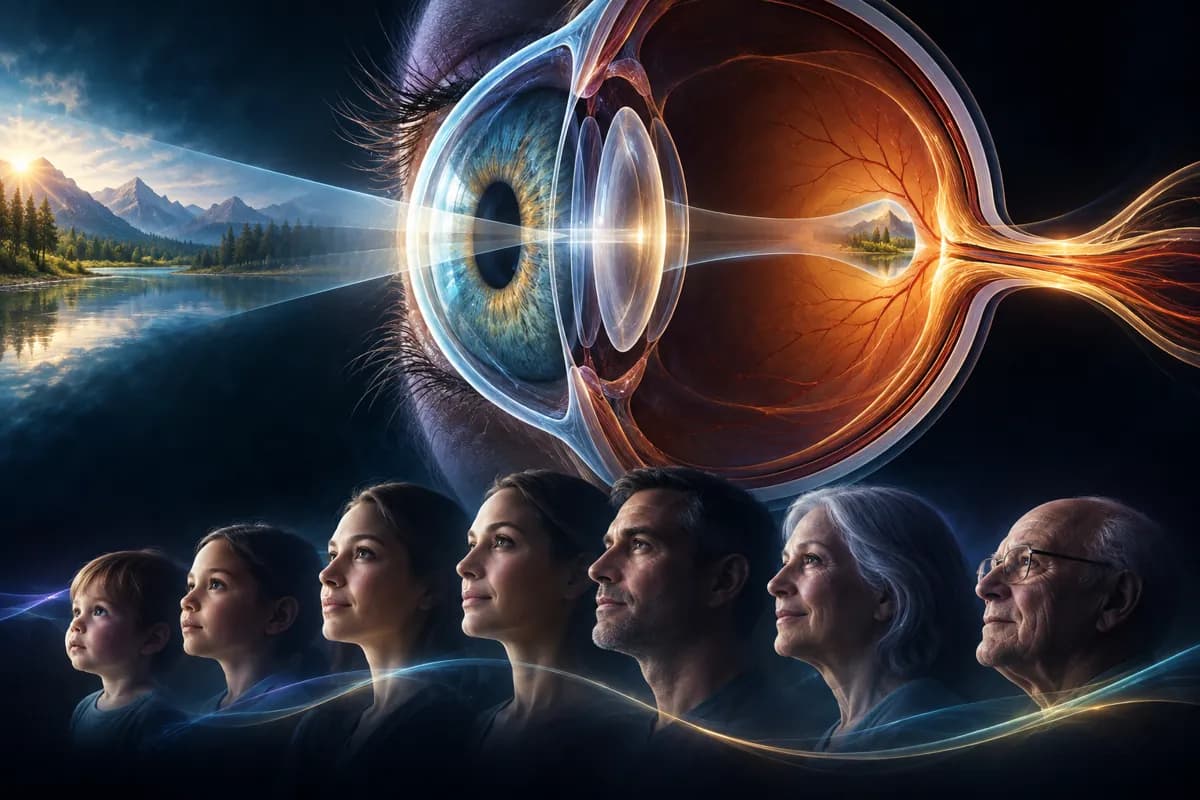
The eye is a complex structure often likened to a camera, with key components like the cornea, iris, pupil, lens, retina and optic nerve working together to focus light and create images. The cornea acts as a protective covering, while the iris controls how much light enters through the pupil. Images are focused by the lens onto the retina, which contains photoreceptor cells that convert light into signals carried to the brain via the optic nerve.
Several common vision conditions arise when there are problems with refractive errors in the shape or length of the eye impacting the focus of light. Nearsightedness, or myopia, occurs when the eyeball is too long or the cornea is too curved, causing close objects to be in focus but distant objects to appear blurry. Farsightedness results from an eyeball that is too short or a cornea that is too flat, making distant objects clearer but close-up vision more difficult. Astigmatism happens when the cornea or lens has an irregular curvature.
Correcting Refractive Errors in Vision
There are several options for correcting refractive errors, including glasses, contact lenses or laser eye surgery. Glasses and contacts help bend light before it enters the eye to achieve better focus. Laser eye surgeries like PRK and LASIK use lasers to subtly reshape the cornea and reduce nearsightedness, farsightedness or astigmatism.
PRK was the first type of laser eye surgery approved in the 1990s. It involves gentle abrasion of the outer corneal layer called epithelium before lasers reshape the cornea underneath by vaporizing thin layers of tissue. A contact lens protects the cornea as the epithelium regenerates within a few days. LASIK soon followed, creating a thin flap on the cornea before lasers treat its deeper layers. The flap then lays back in place for rapid healing.
Age-Related Changes in Vision
Two common age-related vision changes are presbyopia and cataracts. Presbyopia occurs as the lens loses elasticity, impacting its ability to change shape and focus on objects at varying distances. This leads to difficulty seeing things up close, typically starting in the 40s.
Cataracts develop when proteins in the lens become damaged and clump together over time, causing cloudiness or opacity that scatters and blocks light. They often form slowly, causing vision changes like faded color perception, blurriness, glare sensitivity and poor night vision. Surgery to remove cataracts and insert artificial intraocular lenses can restore visual clarity usually with dramatic results.
Protecting Eye Health with Lifestyle Factors
Lifestyle factors play an important role in optimizing long-term eye health. Regular eye exams help detect issues early, while safety practices like wearing sunglasses and eye protection shield eyes from damage. Ensuring children spend ample time outdoors and limiting close-up screen activities may help avoid worsening myopia progression. Dietary intake of leafy greens, fish, and antioxidant supplements support eye health.
Artificial tears relieve dry eye discomfort, and avoiding sleeping in contacts reduces infection risk. Blue light-blocking software helps balance screen use in evenings. Overall, being proactive with eye protection, eye exams, managing prescriptions and vision aids can maintain eye health and vision at its best through all life stages.